

Posted on February 1, 2004
Introducing the Humidor CL Server. It is the largest humidor that I have modified and the most expensive, both in component costs and stuff blown up. I was inspired by the article published on this site "EPIA CL Linux Firewall/Router Project". VIA had given me a CL10000 mainboard to build something for display at CES in Las Vegas. I re-read the firewall project and noticed that it utilized three separate boxes; the computer, a DSL modem and a wireless router. I had seen a picture of a Hush computer in service at someone's home and had been dumbfounded by the fact that this beautiful computer had an butt-ugly modem and router stacked on top of it with all the sundry cables winding around connecting everything. At the same time, I had been sitting on this art deco humidor I had acquired some months before. It turned out to be much bigger than I had imagined. The plan was to put all three "boxes" inside the humidor and have them all powered from a common power supply. The server would operate headless, 24/7, from my living room, which is the center of my "estate" and therefore the preferred location for the wireless system. The only cables would be the phone line for the DSL signal and of course, power.
The computer has Microsoft Windows 2003 Server, Enterprise Edition, installed. It is also running Winproxy which handles all the Internet access setup, anti-virus protection, web caching, spam blocking and content filtering for the entire network. One of the interesting tasks in the project was "dumbing down" the wireless router. The CL was going to do all the firewall, routing and DHCP chores. I only needed the wireless unit to distribute the access. I turned off its built-in DHCP server, assigned it a static address and connected it to the CL using a cross-over cable connected to one of its wired Ethernet ports. Instant wireless hub.
On to the pictures.
|
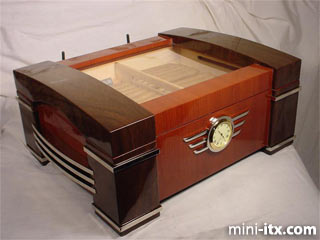
The completed project. My initial intention was to go "full stealth" but for reasons unknown to me I insisted on leaving a few clues to the underlying functionality. I should know better than to argue with myself. Can you see the clues?
|
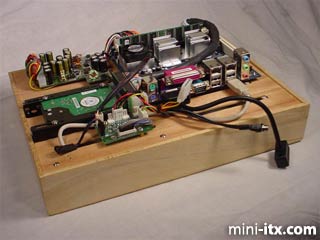
|
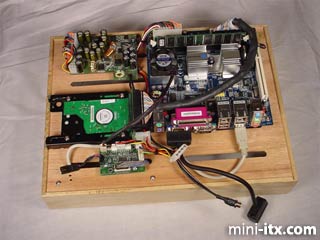
A tour from top left. The power supply. I operate it at 60W in this application but it is capable of 150W using a higher capacity external "brick". The mainboard. VIA CL10000 with Nehemiah core, 256MB of DDR memory and a much quieter fan than stock. The Crystalfontz 631 LCD daughter board. At this writing it is unavailable to the public. It provides an attachment point for the 631's optional ATX power control, fan control and temperature sensing cables. The daughter board itself is connected by cable to the main LCD display. The 631 was designed to fit into a 3.5" bay. Space constraints required Crystalfontz to break the PCB into two parts. The display itself is mounted directly on the other side of the tray. The hard drive. I started with a 3.5" 120GB drive. There is room but I was concerned about cable clearance when the tray was mounted to the lower section. I decided to eliminate the issue by using a 40GB Toshiba 2.5" drive.
|
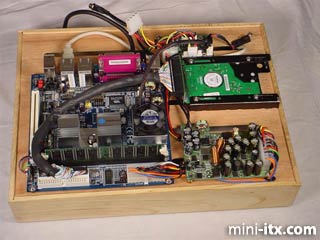
Reverse shot of component tray.
|
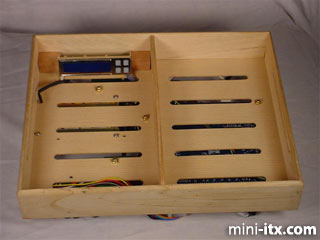
Flipped over. The Crystalfontz 631 display is seen mounted with an attached digital thermometer sticking out from it. All the components on the other side are mounted to the wood using brass PCB spacers. On this side I threaded brass acorn nuts onto the exposed threads. This provided the additional strength that was going to be required for shipping the unit. Lessons learned.
|
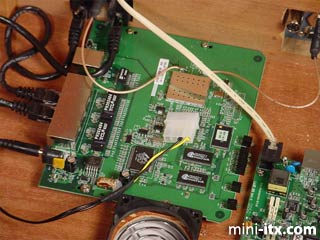
Moving on to the lower case. This is a naked Linksys wireless router with a 4-port hub mounted to the bottom of the inside of the humidor. Removing the external plastic case sure did reduce the size of the unit but it also exposes it to "electrical events". This is my second unit, having let out the magic blue smoke from the other.
 |
 |
 |
Quick Links
Mailing Lists:
Mini-ITX Store
Projects:
Show Random
Accordion-ITX
Aircraft Carrier
Ambulator 1
AMD Case
Ammo Box
Ammo Tux
AmmoLAN
amPC
Animal SNES
Atari 800 ITX
Attache Server
Aunt Hagar's Mini-ITX
Bantam PC
BBC ITX B
Bender PC
Biscuit Tin PC
Blue Plate
BlueBox
BMW PC
Borg Appliance
Briefcase PC
Bubbacomp
C1541 Disk Drive
C64 @ 933MHz
CardboardCube
CAUV 2008
CBM ITX-64
Coelacanth-PC
Cool Cube
Deco Box
Devilcat
DOS Head Unit
Dreamcast PC
E.T.PC
Eden VAX
EdenStation IPX
Encyclomedia
Falcon-ITX
Florian
Frame
FS-RouterSwitch
G4 Cube PC
GasCan PC
Gingerbread
Gramaphone-ITX-HD
GTA-PC
Guitar PC
Guitar Workstation
Gumball PC
Hirschmann
HTPC
HTPC2
Humidor 64
Humidor CL
Humidor II
Humidor M
Humidor PC
Humidor V
I.C.E. Unit
i64XBOX
i-EPIA
iGrill
ITX Helmet
ITX TV
ITX-Laptop
Jeannie
Jukebox ITX
KiSA 444
K'nex ITX
Leela PC
Lego 0933 PC
Legobox
Log Cabin PC
Lunchbox PC
Mac-ITX
Manga Doll
Mantle Radio
Mediabox
Mega-ITX
Micro TV
Mini Falcon
Mini Mesh Box
Mini-Cluster
Mobile-BlackBox
Moo Cow Moo
Mr OMNI
NAS4Free
NESPC
OpenELEC
Osh Kosh
Pet ITX
Pictureframe PC
Playstation 2 PC
Playstation PC
Project NFF
PSU PC
Quiet Cubid
R2D2PC
Racing The Light
RadioSphere
Restomod TV
Robotica 2003
Rundfunker
SaturnPC
S-CUBE
SEGA-ITX
SpaceCase
SpacePanel
Spartan Bluebird
Spider Case
Supra-Server
Teddybear
Telefunken 2003
TERA-ITX
The Clock
ToAsTOr
Tortoise Beetle
Tux Server
Underwood No.5
Waffle Iron PC
Windows XP Box
Wraith SE/30
XBMC-ION